> For the complete documentation index, see [llms.txt](https://ahmed-tarek.gitbook.io/security-notes/llms.txt). Markdown versions of documentation pages are available by appending `.md` to page URLs; this page is available as [Markdown](https://ahmed-tarek.gitbook.io/security-notes/notes/active-directory-pentesting/post-compromise-attacks/kerberoasting-attack.md).
# Kerberoasting Attack
#### **How Kerberoasting Works**
* In Active Directory (AD), service accounts are used to run specific services or applications, such as web servers or database systems.
* These services are associated with a Service Principal Name (SPN), which uniquely identifies them.
* Any authenticated AD user can request a Ticket Granting Service (TGS) ticket for any SPN in the domain.
* The TGS is encrypted using the service account's NTLM hash (derived from its password).
* Now the attacker requests a TGS for a service with a known SPN.
* The TGS is then extracted from memory using tools like **Rubeus** or **Impacket**.
* The attacker uses tools like **Hashcat** or **John the Ripper** to brute force or dictionary attack the TGS offline.
* If successful, this reveals the service account's plaintext password.
## How to do it?
#### **1. Identify Service Principal Names (SPNs)**
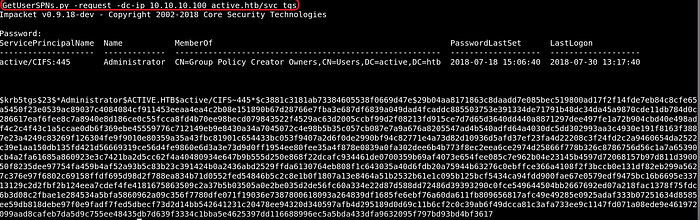
With valid admin or standard user credentials, you can use `GetUserSPNs.py` (from [Impacket](https://github.com/fortra/impacket)) to enumerate SPNs and request TGS tickets for those services.
```bash
GetUserSPNs.py -request -dc-ip
```
* **`-request`**: Requests TGS tickets for the identified SPNs.
* **``**: IP address of the Domain Controller.
* **``**: The username and domain to authenticate with.
TGS ticket dump from Attacker’s PC
* When you request TGS tickets, the tool will dump the tickets in a format that can be used for offline cracking.
* The extracted **TGS hashes** are encrypted with the NTLM hash of the associated service account's password.
#### **3. Crack the TGS Hash**
* Use **Hashcat** to brute-force the NTLM hash of the service account password offline.
* The hash type for TGS tickets is **13100** in Hashcat.
```bash
hashcat -m 13100
```
**Important note:** If any of the above test gives a negative result, keep an eye on your Wireshark traffic. Mostly setting up static DHCP or DNS or Gateway IP address solves such issues. This is a very small thing to underestimate which will affect the pentest in a peculiar way.\\
## **Mitigations:**
* If possible use [group managed service accounts](https://technet.microsoft.com/en-us/library/hh831782%28v=ws.11%29.aspx?f=255\&MSPPError=-2147217396) which have random, complex passwords (>100 characters) and are managed automatically by Active Directory
* Ensure all service accounts (user accounts with Service Principal Names) have long, complex passwords greater than 25 characters, preferably 30 or more. This makes cracking these password far more difficult.
* Service Accounts with elevated AD permissions should be the focus on ensuring they have long, complex passwords.
* Ensure all Service Account passwords are changed regularly
## **Shout outs:**
* [Cracking Kerberos TGS Tickets Using Kerberoast — Exploiting Kerberos to Compromise the Active Directory Domain](https://adsecurity.org/?p=2293)
* [Attack Methods for Gaining Domain Admin Rights in Active Directory](https://adsecurity.org/?p=2362)
* [Sneaky Persistence Active Directory Trick #18: Dropping SPNs on Admin Accounts for Later Kerberoasting](https://adsecurity.org/?p=3466)
* [Targeted Kerberoasting (Harmj0y)](http://www.harmj0y.net/blog/activedirectory/targeted-kerberoasting/)
* Tim Medin’s DerbyCon “Attacking Microsoft Kerberos Kicking the Guard Dog of Hades” presentation in 2014 ([slides](https://files.sans.org/summit/hackfest2014/PDFs/Kicking%20the%20Guard%20Dog%20of%20Hades%20-%20Attacking%20Microsoft%20Kerberos%20%20-%20Tim%20Medin%281%29.pdf) & [video](https://www.youtube.com/watch?v=PUyhlN-E5MU\&feature=youtu.be)).
---
# Agent Instructions
This documentation is published with GitBook. GitBook is the documentation platform designed so that both humans and AI agents can read, navigate, and reason over technical content effectively. Learn more at gitbook.com.
## Querying This Documentation
If you need additional information that is not directly available in this page, you can query the documentation dynamically by asking a question.
Perform an HTTP GET request on the current page URL with the `ask` query parameter, and the optional `goal` query parameter:
```
GET https://ahmed-tarek.gitbook.io/security-notes/notes/active-directory-pentesting/post-compromise-attacks/kerberoasting-attack.md?ask=&goal=
```
`ask` is the immediate question: it should be specific, self-contained, and written in natural language.
`goal` is optional and describes the broader end goal you are ultimately trying to accomplish on behalf of the user. GitBook uses it to tailor the answer towards what is most useful for that goal.
The response will contain a direct answer to the question and relevant excerpts and sources from the documentation.
Use this mechanism when the answer is not explicitly present in the current page, you need clarification or additional context, or you want to retrieve related documentation sections.